1. What is Generative Engine Optimization (GEO)?
Generative Engine Optimization (GEO) is the process of improving website content, business information, technical accessibility, and online authority so that generative AI systems can better understand and potentially reference a business in AI-generated answers.
2. How does GEO differ from traditional SEO?
Traditional SEO focuses on improving organic search visibility through relevant content, technical optimization, and authority. GEO builds on those foundations by considering how AI-powered systems retrieve information, synthesize answers, and potentially reference sources.
3. Why is GEO important for businesses?
GEO helps businesses prepare for changing search behaviour, where customers may use AI platforms to research companies, compare services, and find recommendations. A clear, useful, and credible digital presence can create additional opportunities for discovery.
4. Can GEO help my business appear in ChatGPT?
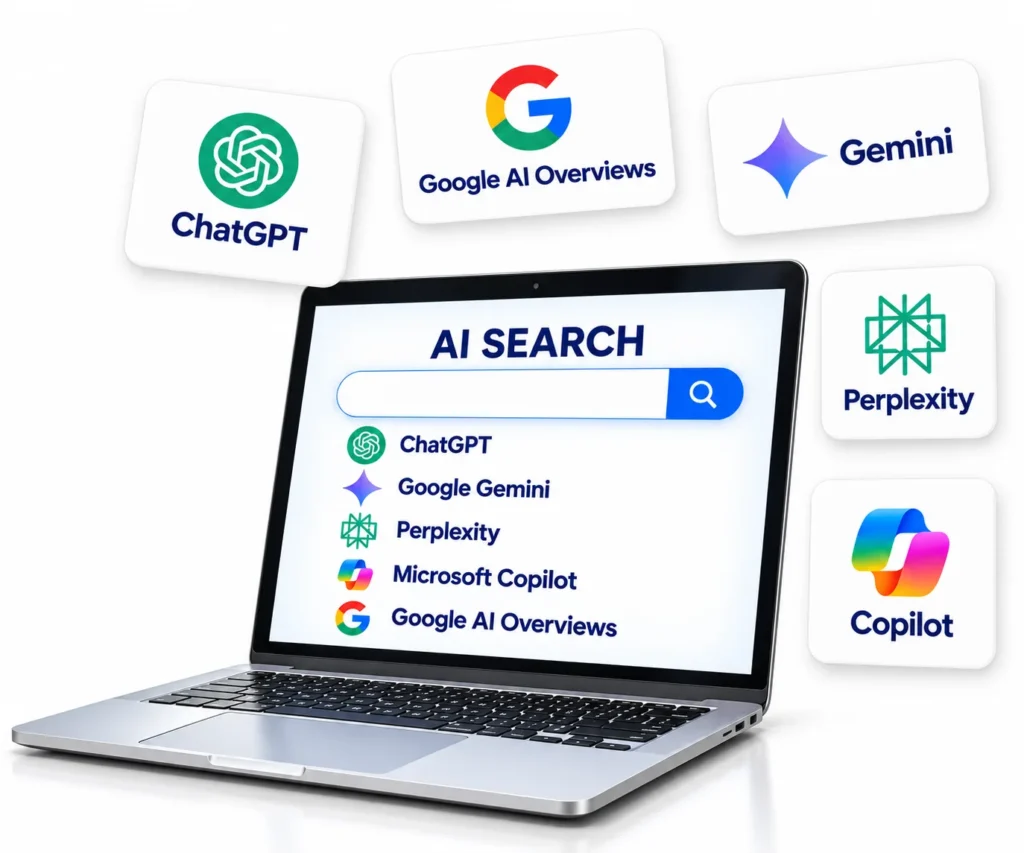
GEO can help improve the clarity, relevance, accessibility, and credibility of your online information. However, no agency can guarantee that ChatGPT will mention, recommend, or cite a particular business for a specific query.
5. Does GEO help with Google AI Overviews?
GEO can complement SEO practices that support search visibility, including helpful content, technical accessibility, topical relevance, and clear answers. Inclusion in Google AI Overviews is not guaranteed and depends on Google's systems and the particular search.
6. What is the difference between GEO and AEO?
GEO focuses on improving how business information may be understood and referenced in generative AI experiences. AEO focuses on organizing content to provide clear and useful answers to user questions. Both can complement a strong SEO strategy.
7. What services are included in GEO?
GEO services may include AI search audits, query research, content optimization, entity optimization, technical SEO, schema markup, digital authority development, local SEO, and AI visibility monitoring.
8. How long does GEO take to show results?
The timeline varies based on your website's current condition, industry competition, content quality, technical issues, and implementation speed. Improvements generally require ongoing optimization, and there is no universal timeline for AI visibility.
9. How do you measure GEO performance?
Performance can be evaluated using organic search rankings, impressions, clicks, traffic, conversions, brand mentions, AI citations where observable, and referral traffic where available. AI responses vary, so monitoring should use a consistent set of relevant queries and clearly defined measurement methods.
10. Is GEO suitable for small and local businesses?
Yes. Small and local businesses can use GEO alongside local SEO by publishing clear service information, answering customer questions, maintaining accurate business profiles, building genuine reputation signals, and creating relevant location-specific content.
11. Does schema markup guarantee AI citations?
No. Structured data helps search engines interpret information on a website, but it does not guarantee rankings, AI citations, or inclusion in generated answers. Schema should accurately describe content that is present on the page.
12. Do you provide GEO services in Canada and the USA?
AISEO GEO provides GEO-focused search optimization strategies for businesses targeting Canada and the USA. The recommended approach depends on your market, competition, services, and business objectives.